 Airman Vision
The work
Ideas, in detail.
Each part of Airman Vision starts as a working prototype on local NVIDIA hardware. Here is what each one does, how it is built, and where it goes next.
Product 01
Private AI Appliance
Your files. Your models. Inside your building.
Most people's first experience with AI is a chat window that sends every question to a company they have never met. For a law office, a clinic or a defense supplier, that is a non starter. The appliance flips it around. A language model runs on a machine in the server closet, reads the organization's own documents, and answers questions about them without a single byte going out the door.
Working local demo
Ollama serves the models and Open WebUI gives people a familiar chat screen. NVIDIA Nemotron, Qwen and Gemma models are in rotation, with retrieval over customer files so answers point back to the source document.
Named, installable release
The next version moves to NVIDIA NIM for model serving, NeMo Retriever for document search, and NeMo Guardrails for safety rules, all packaged as a single image that installs the same way every time.
Release gate: publish real speed numbers for every tier.
Tiers are planned around office size, roughly 5, 25 and 75 people, so each one gets measured on the hardware it would actually run on.
Inside the appliance
Local agent. Human authority.
Working today on a single RTX 5060 Ti: Ollama, Open WebUI, and MCP tools that let the model drive a browser and a PC.
An agent that can click buttons is powerful and a little scary. So the design puts a person in the loop on purpose. The model can ask to do something. Safety rules decide whether it is even allowed to ask. A human approves each action. Then it runs, and every step is written to a log.
Next: this becomes the appliance's built in assistant, with NVIDIA NIM for models and NeMo Guardrails for safety rules.
Product 02
Firearm and aggression detection
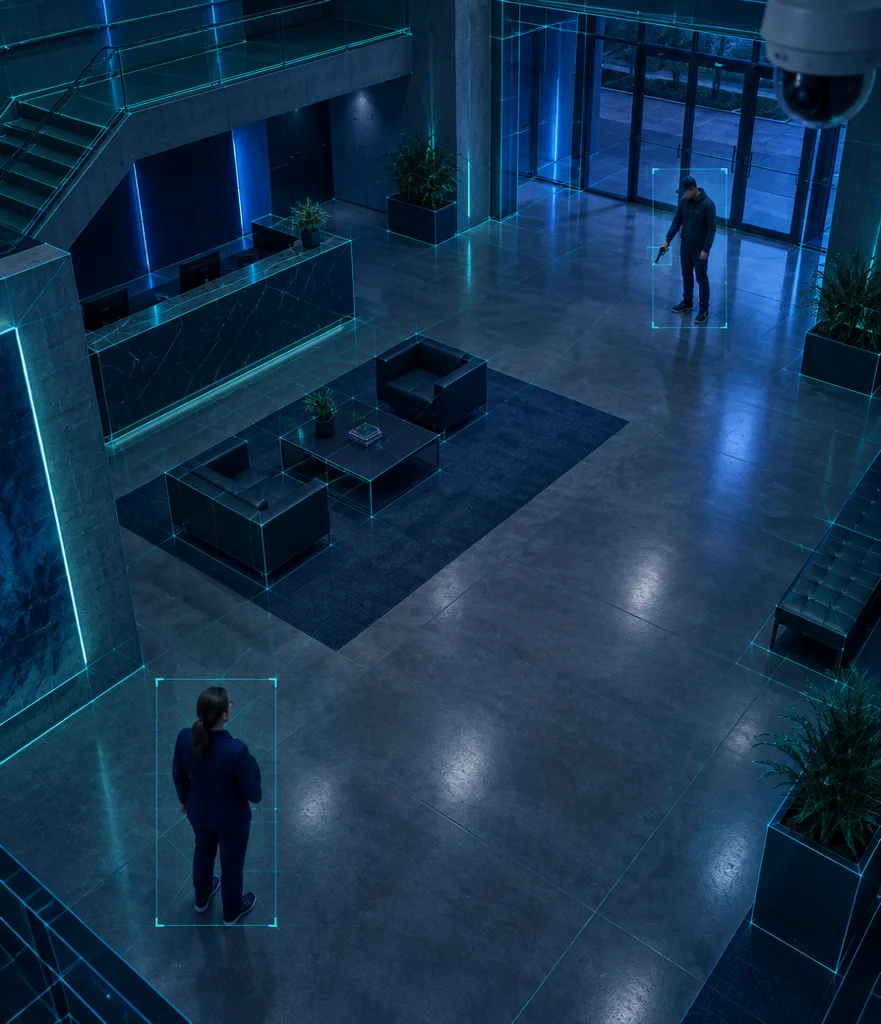
The goal is simple to say and hard to do: notice a drawn weapon or a fight on a security camera fast enough to matter, and be right often enough that people trust the alert.
Speed comes from running the detector at the edge, next to the cameras. Trust comes from a second check. Every gun or fight clip is handed to an open source vision language model that looks at the whole clip and decides whether it is real before a human is ever paged.
Once firearms and fights are proven, the same pipeline extends to falls, loitering, and fire and smoke.
Publish accuracy and false alarm rates.
The hardest problem
Solve the data first.
Synthetic drawn weapon scenes address the shortage of real footage.
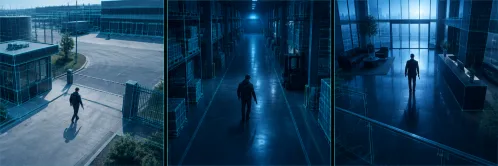
You cannot train a model on events that almost never get recorded. So Airman Vision builds them. NVIDIA Cosmos and Omniverse Replicator generate thousands of realistic scenes, varied by lighting, camera angle, clothing and setting. Those scenes train a model in TAO, TensorRT makes it fast, and DeepStream runs it on live video.
Architecture
Edge speed. Core intelligence.
An NVIDIA reference design for live detection and continuous retraining.
Cameras to Jetson to alert
Cameras feed an NVIDIA Jetson running DeepStream and Metropolis. Detection happens right there, in milliseconds, and raises an alert without a round trip to anywhere.
Review and retrain
Alerts flow up to a DGX or cloud instance where a vision language model reviews them. Mistakes become training data, the model is retrained, and updated models are pushed back down to the edge.
The system gets better from its own mistakes.
Footage search
Search footage in plain English.
Type what you are looking for. Get the moment.
Traditional video search means scrubbing timelines or relying on a fixed list of object labels. An open vocabulary vision language model understands descriptions it was never explicitly trained on, so a question like the one above just works. It is built on the NVIDIA video search and summarization blueprint, and it is a natural fit for live demonstrations.
Product 03
From network findings to compliance evidence.
Network defense agent, prototype running.
Defense suppliers working toward CMMC do not just need alerts. They need proof, organized the way an assessor reads it. The agent watches network traffic with custom models, adds NVIDIA Morpheus for phishing detection and digital fingerprinting, and maps what it finds to CMMC controls.
For defense suppliers: a compliance report, not just alerts.
Analytics layer
Crime Locater
The analytics layer connecting cameras and data.
Detection events from cameras mean more when they sit next to what is happening in the neighborhood. Crime Locater combines those events with public crime data and runs the whole thing on NVIDIA RAPIDS cuDF, so dashboards that would crawl on a CPU stay interactive on a GPU.
Publish GPU vs CPU speedup.